
KEY TAKEAWAYS
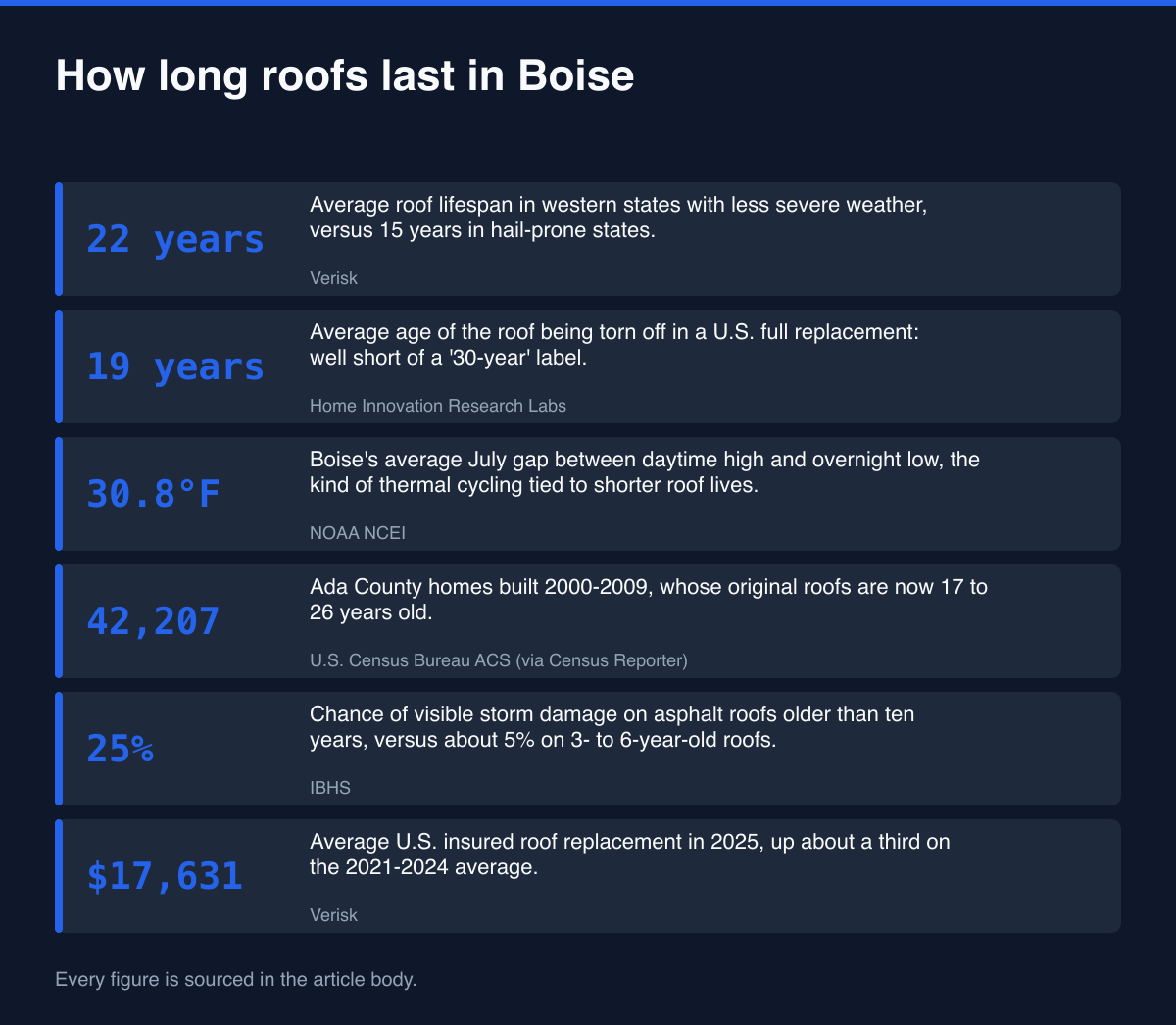
- → 22 years Average roof lifespan in western states with less severe weather, versus 15 years in hail-prone states. (Verisk, 2024)
- → 19 years Average age of the roof being torn off in a U.S. full replacement: well short of a '30-year' label. (Home Innovation Research Labs, 2017)
- → 30.8°F Boise's average July gap between daytime high and overnight low, the kind of thermal cycling tied to shorter roof lives. (NOAA NCEI, 2020)
- → 42,207 Ada County homes built 2000-2009, whose original roofs are now 17 to 26 years old. (U.S. Census Bureau ACS (via Census Reporter), 2024)
- → 25% Chance of visible storm damage on asphalt roofs older than ten years, versus about 5% on 3- to 6-year-old roofs. (IBHS, 2020)
- → $17,631 Average U.S. insured roof replacement in 2025, up about a third on the 2021-2024 average. (Verisk, 2025)
- → 2 percent Share of homeowners who blamed a replacement on premature failure; most roofs are replaced for leaks, storms or visible wear. (Home Innovation Research Labs, 2017)
Most Boise homeowners were told their roof would last as long as the number on the shingle bundle. The data says otherwise. Verisk, which analyzes roof age and insurance claims nationwide, puts the average roof lifespan at 22 years in western states with less severe weather and 15 years in hail-prone states (Verisk, 2024). The average roof torn off in a U.S. full replacement is only a little past 19 years old (Home Innovation Research Labs, 2017).
This page pulls together the published numbers on how long asphalt roofs actually last, what the warranty behind a “30-year” or “lifetime” shingle really promises, how Boise’s heat and big day-to-night temperature swings age a roof, and how many Treasure Valley homes are reaching the replacement window right now. Every figure links to its source. Where no Boise-specific data exists, we say so and show the closest measured substitute.
1 How Long Does an Asphalt Shingle Roof Actually Last?
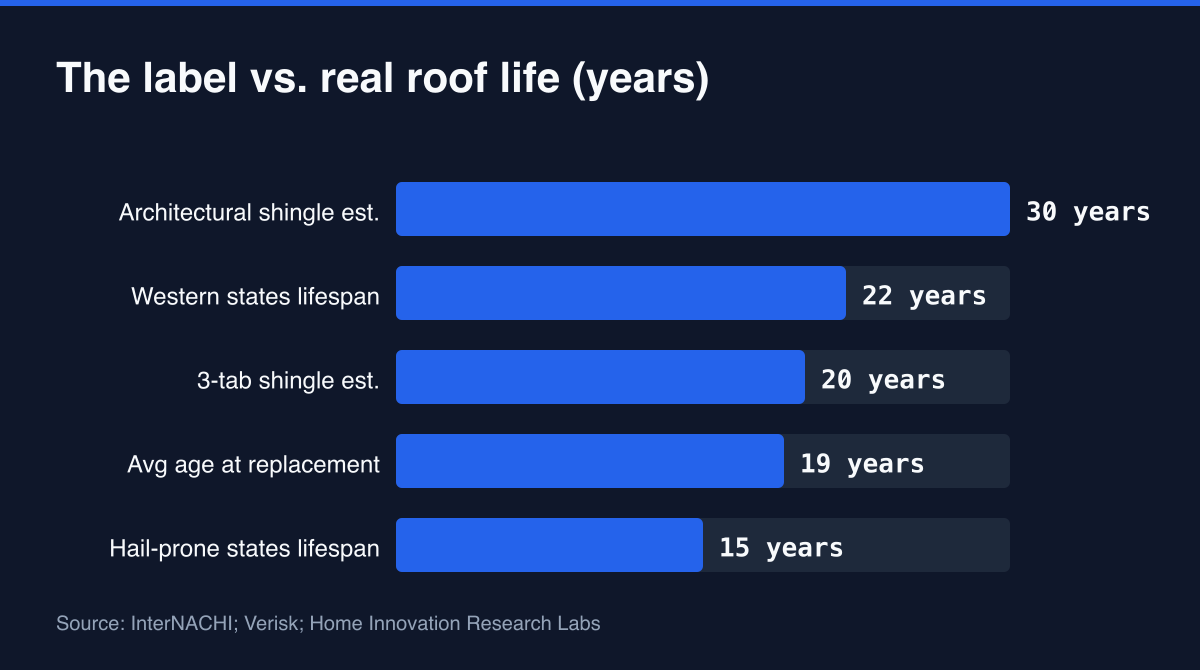
Roughly two decades, not three. Verisk reports an average roof lifespan of 22 years in western states with milder weather and 15 years in hail-prone states. Home Innovation Research Labs found the roofing removed in U.S. full replacements averaged slightly more than 19 years old (Home Innovation Research Labs, 2017), well under the “30-year” class most homeowners remember buying.
| METRIC | VALUE | SOURCE |
|---|---|---|
| Average roof lifespan, western states | 22 years | Verisk |
| Average roof lifespan, hail-prone states | 15 years | Verisk |
| Average age of roofing removed in a full replacement | 19 years | Home Innovation Research Labs |
| Inspector estimate, architectural shingles (years) | 30 | InterNACHI |
| Inspector estimate, 3-tab shingles (years) | 20 | InterNACHI |
| Average roof age, Nevada (years) | 16.2 | Nearmap via Risk & Insurance |
| Average roof age, Louisiana (years) | 8.9 | Nearmap via Risk & Insurance |
| Share of U.S. roofs that are asphalt shingle | 80 percent | Verisk |
The gap between the label and the lifespan is the first thing to understand. InterNACHI, the largest home inspector association, uses 30 years for architectural shingles and 20 for older 3-tab shingles as planning figures (InterNACHI, 2026), and adds a caveat that matters in southwest Idaho: hot climates drastically reduce asphalt shingle life. Measured replacement ages sit closer to the bottom of those ranges than the top. Since asphalt covers 80 percent of American roofs (Verisk, 2024), this is the number most Boise homeowners actually need, and it is why our asphalt shingle roofing estimates plan around a realistic service life rather than the product name.
Geography moves the number more than brand. An analysis of aerial imagery by Nearmap, reported by Risk & Insurance, found the average roof age ranges from 16.2 years in Nevada to just 8.9 years in Louisiana (Nearmap via Risk & Insurance, 2026). Boise sits in the dry West, closer to Nevada than to the Gulf Coast, which is good news. But dry does not mean gentle, as the climate data below shows. If you are weighing materials for a longer horizon, the lifespan gap is one reason homeowners compare metal roofing in Boise against architectural shingles.
2 What Does a “30-Year” or “Lifetime” Shingle Warranty Actually Promise?
A warranty class, not a lifespan. On Owens Corning’s standard limited lifetime warranty, “lifetime” means as long as the original owner owns the home, and covered costs are paid in full only for the first 10 years. From year eleven coverage drops to 80% and keeps falling every year after that (Owens Corning, 2026).
| METRIC | VALUE | SOURCE |
|---|---|---|
| Full-coverage period on a lifetime shingle (years) | 10 | Owens Corning |
| Coverage in year eleven, then reduced each year | 80% | Owens Corning |
| Replacements triggered by leaking | one-third | Home Innovation Research Labs |
| Replacements blamed on premature failure | 2 percent | Home Innovation Research Labs |
| Replacements done to improve appearance | 3 percent | Home Innovation Research Labs |
Manufacturer warranties cover manufacturing defects, prorated over time. They are not a promise that the roof will keep water out for thirty or fifty years, and they exclude most of what actually ends a roof’s life: weather, ventilation problems, installation errors and ordinary wear. By the time a typical roof reaches replacement age, a prorated warranty pays only a fraction of the cost, which is why the warranty rarely comes up when Boise homeowners get a roof replacement.
Home Innovation’s homeowner survey shows how roofs really end. About one-third of full replacements were triggered by leaking and about a third by storm damage, while only 2 percent of homeowners said the roof failed prematurely and 3 percent replaced it for looks (Home Innovation Research Labs, 2017). In other words, most roofs are replaced when they start letting water in or get hit by weather, not on a schedule printed on the bundle. That makes the condition of the roof, not its warranty, the thing worth tracking.
3 How Does Boise’s Climate Age a Roof?
Through heat and big daily temperature swings. NOAA’s 1991-2020 normals put Boise’s average July gap between the daily high and low at 30.8°F°F, with about 54.9 days a year at 90°F or hotter and 108.2 nights at or below freezing (NOAA NCEI, 2020). Nearmap links wide daily swings to measurably younger roofs.
| METRIC | VALUE | SOURCE |
|---|---|---|
| Boise average daily temperature swing, annual (°F) | 22.3 | NOAA NCEI |
| Boise average daily temperature swing, July (°F) | 30.8°F | NOAA NCEI |
| Boise days per year at 90°F or hotter | 54.9 | NOAA NCEI |
| Boise days per year at 100°F or hotter | 9.1 | NOAA NCEI |
| Boise nights per year at or below 32°F | 108.2 | NOAA NCEI |
| Average roof age, counties with daily swings above 23°F (years) | 9.0 | Nearmap via Risk & Insurance |
| Average roof age, counties with daily swings below 20°F (years) | 11.1 | Nearmap via Risk & Insurance |
| Roof-age gap attributed to thermal stress alone | 23% | Nearmap via Risk & Insurance |
Nearmap’s analysis of more than two billion roof images found that counties where the mean daily temperature swing exceeds twenty-three degrees have an average roof age of 9.0 years, against 11.1 years where swings stay under twenty degrees, a 23% difference it attributes to thermal stress alone (Nearmap via Risk & Insurance, 2026). Boise’s year-round average swing is 22.3°F (NOAA NCEI, 2020), just under that top band, but from late spring through early fall it runs far above it. Those are the same months when shingles bake under high-desert sun on roughly 9.1 days a year that reach triple digits.
Winter adds its own wear. Freezing nights drive freeze-thaw cycling at the eaves and around flashing, the details our Boise roof replacement cost guide flags as the difference between a roof that ages normally and one that fails early. No public study measures roof lifespan in Boise itself, so treat these as the climate forces a local roof works against, not a Boise-specific life expectancy. The practical takeaway is that ventilation and installation quality matter more here than in a mild coastal climate, and a periodic roof inspection in Boise catches heat and freeze damage before it becomes a leak.
4 Why Does a Roof Get So Much More Vulnerable After Year Ten?
Weathering weakens shingles long before they leak. In IBHS’s survey after the Cedar Rapids derecho, asphalt roofs older than ten years had about a 25% probability of visible damage, compared with 5% for 3- to 6-year-old roofs (IBHS, 2020). IBHS lab tests found weathered shingles hit by small hail became ten times more susceptible to later large hail.
| METRIC | VALUE | SOURCE |
|---|---|---|
| Visible storm damage, roofs older than ten years | 25% | IBHS |
| Visible storm damage, 3- to 6-year-old roofs | 5% | IBHS |
| Weathered shingles after small hail vs. new | ten times | IBHS / Frontiers in Materials |
| Homes with roofs nine years old or newer, hail states | 57 percent | Verisk |
| Homes with roofs nine years old or newer, non-hail states | 38 percent | Verisk |
| Higher loss costs, moderate-to-poor roofs vs. good | 60 percent | Verisk |
The Insurance Institute for Business & Home Safety found a statistically significant jump in damage for roofs from seven to eight years old and again from nine to ten (IBHS, 2020). Its later peer-reviewed study, run on shingles weathered at the IBHS aging farm, showed that repeated small hail strips protective granules and speeds up natural aging (IBHS / Frontiers in Materials, 2025). Treasure Valley storms often bring exactly that kind of small hail and strong outflow wind, which is why a roof’s age changes how you should respond after a storm, as our storm and hail damage guide explains.
Replacement cycles follow the weather. In Verisk’s hail-designated states, 57 percent of homes have roofs nine years old or newer, compared with 38 percent in non-hail states (Verisk, 2025), so roofs in calmer places live longer but also age into the vulnerable band. Condition matters as much as age: Verisk found roofs visibly in moderate-to-poor condition carry about 60 percent higher loss costs than roofs in good shape. If a recent storm has you wondering, storm damage roof repair starts with documenting what an older roof actually took.
5 How Many Treasure Valley Roofs Are Coming Due Now?
Tens of thousands. The Census Bureau’s 2024 American Community Survey counts 42,207 Ada County homes built between 2000 and 2009, whose original roofs are now 17 to 26 years old, plus 39,186 built in the 1990s (U.S. Census Bureau ACS (via Census Reporter), 2024). Many have been reroofed, but this decade of building is squarely inside the typical replacement window.
| METRIC | VALUE | SOURCE |
|---|---|---|
| Ada County homes built 2000-2009 | 42,207 | U.S. Census Bureau ACS (via Census Reporter) |
| Ada County homes built 1990-1999 | 39,186 | U.S. Census Bureau ACS (via Census Reporter) |
| Ada County homes built 2010-2019 | 43,459 | U.S. Census Bureau ACS (via Census Reporter) |
| Ada County total housing units | 224,134 | U.S. Census Bureau ACS (via Census Reporter) |
| Boise city homes built 2000-2009 | 12,970 | U.S. Census Bureau ACS (via Census Reporter) |
| Boise city homes built 1990-1999 | 21,670 | U.S. Census Bureau ACS (via Census Reporter) |
| Western U.S. roofs 0-4 years old | 20 percent | Verisk |
| Western U.S. roofs 31 years or older | 11 percent | Verisk |
Out of 224,134 housing units in Ada County, 42,207 went up in the first decade of this century and another 43,459 in the decade after (U.S. Census Bureau ACS (via Census Reporter), 2024). Inside Boise city limits the older stock dominates: 21,670 homes date from the 1990s and 12,970 from the following decade. Subdivisions built in the same few years tend to have roofs installed in the same few years, so whole neighborhoods in Meridian and Eagle reach replacement age together.
These are housing units, not original roofs. Many homes from the 1990s, and plenty from the following decade, have already been reroofed after hail, wind or ordinary wear, so read the counts as an upper bound on original roofs still in service. Regionally, Verisk’s roof-age data shows 20 percent of roofs in the West are four years old or newer and 11 percent are thirty-one years or older (Verisk, 2025). The Treasure Valley’s timeline puts a large share of local homes between those two groups, in the years when a roof shifts from routine repair to planning a replacement.
6 What Does Waiting on an Aging Roof Cost?
More every year. Verisk’s 2026 U.S. Roof Report puts the average insured residential roof replacement at $17,631 in 2025 and the average repair at $4,699, with replacement costs up 33 percent on the 2021-2024 average (Verisk, 2025). Roofing material costs also kept rising, by 1.48 percent in 2025.
| METRIC | VALUE | SOURCE |
|---|---|---|
| Average insured roof replacement, 2025 | $17,631 | Verisk |
| Average insured roof repair, 2025 | $4,699 | Verisk |
| Replacement cost rise vs. 2021-2024 average | 33 percent | Verisk |
| Roofing material cost increase, 2025 | 1.48 percent | Verisk |
| Asphalt-shingle homes with under four years of roof life left | 29 percent | Verisk |
| U.S. homes with moderate-to-poor roof condition | 38 percent | Verisk |
| Florida roof age below which insurers cannot refuse on age alone | 15 years | Florida Legislature |
| Claimed life extension from repeated rejuvenation sprays | 15 years (commonly cited; no primary source traceable) | Tri-Cities Area Journal of Business (Roof Maxx claim) |
Verisk estimates that 29 percent of U.S. homes with asphalt shingles have less than four years of useful roof life remaining (Verisk, 2024), and aerial imagery shows 38 percent of homes with a roof in moderate-to-poor condition. Those figures come from insurers, and insurers act on them. Florida’s legislature had to set a rule that carriers may not refuse coverage solely because a roof is under 15 years old (Florida Legislature, 2022). Idaho has no comparable statute, so an older roof can affect your coverage options here; ask your agent how your policy treats roof age before you need to file a claim. Our repair vs. replacement guide covers how to weigh a fix against a full tear-off.
Short of replacement, spray-on rejuvenation products promise extra years. Roof Maxx says repeating its soy-based treatment can extend a roof’s life by up to 15 years (commonly cited; no primary source traceable) (Tri-Cities Area Journal of Business (Roof Maxx claim), 2019), citing testing by Ohio State and Battelle; that is a vendor claim without independent field data, so weigh it accordingly. The dependable way to budget is to know your roof’s real age and condition, price a replacement with our roof cost calculator and plan the work before a storm or a leak chooses the timing for you.
Explore every figure in this article
Use This Data
Reporters, bloggers, realtors and insurance agents are welcome to use any figure or chart on this page. Please credit Boise Idaho Roofers with a link back to this page.
Methodology
We started from the questions Boise-area and U.S. homeowners ask most about roof life, then gathered only figures we could trace to a live source: Verisk’s roof-age and claims reports, Home Innovation Research Labs’ consumer survey, InterNACHI’s inspector guidelines, IBHS field and laboratory studies, manufacturer warranty documents, NOAA’s 1991-2020 climate normals for Boise Air Terminal, and the Census Bureau’s 2024 American Community Survey. Every source URL was fetched and each figure matched against the page. NOAA and Census values come from official data feeds, which our verifier cannot parse as web pages; we confirmed each value directly against those feeds. The IBHS derecho report and the Owens Corning warranty are PDFs we opened and read. Nearmap’s county climate findings come from Risk & Insurance’s report of a gated white paper and are labelled secondary. No public dataset reports roof lifespan for Boise or Idaho specifically, so western-state and climate-band figures are applied here by similarity, not measurement. Housing counts are housing units, not original roofs. Research stages that ran in reduced form: the competitor backlink format filter found no local roofing competitor with an editorial link profile, so it did not inform the format choice, and one of the fifteen search-results checks failed after retries.
- Sources consulted: 31
- Sources cited: 13
- Data freshness: current year: 4, last year: 2, older: 7
- Data range: 2017-01-01 to 2026-09-29
- Research date: 2026-09-29
- Update schedule: Annually, after Verisk's U.S. Roof Report and the ACS 1-year release
- Limitations: No public dataset reports roof age or lifespan for Boise or Idaho specifically; western-state and county-climate figures are applied to Boise by climate similarity. Housing-age counts are housing units, not original roofs. Nearmap figures are taken from Risk & Insurance's report of a gated white paper.
Frequently Asked Questions
How long does an asphalt shingle roof last in Boise?
Plan on roughly 20 to 25 years for a well-installed architectural shingle roof. Verisk puts the average roof lifespan at 22 years in western states with less severe weather, versus 15 years in hail-prone states. Boise's large daily temperature swings and summer heat push toward the lower end, while its modest hail exposure helps. (Verisk, 2024)
Does a 30-year shingle really last 30 years?
Usually not. The '30' is a product and warranty class, not a measured lifespan. Home Innovation Research Labs found the average roof removed in a U.S. full replacement was slightly more than 19 years old, and only 2 percent of homeowners said they replaced a roof because of premature failure. (Home Innovation Research Labs, 2017)
What does a 'lifetime' shingle warranty actually cover?
'Lifetime' means for as long as the original owner owns the home, and full coverage is short. On Owens Corning's standard limited lifetime warranty, covered costs are paid at 100% only for the first 10 years; from year 11 coverage drops to 80% and falls 2% a year after that, so a 20-year-old roof gets a fraction of replacement cost. (Owens Corning, 2026)
Why does Boise's climate wear out roofs?
Heat plus big day-night swings. NOAA's 1991-2020 normals show Boise averages about 55 days a year at 90°F or hotter, 108 nights at or below freezing, and a July gap of 30.8°F between the daily high and low. Nearmap found counties with daily swings above 23°F had roofs 23% younger on average. (NOAA NCEI, 2020)
Does roof age affect storm damage?
Yes, sharply after about year ten. In IBHS's survey of Cedar Rapids after the 2020 derecho, asphalt roofs older than ten years had roughly a 25% probability of visible damage versus about 5% for 3- to 6-year-old roofs. Separate IBHS lab work found weathered shingles hit by small hail became about ten times more susceptible to later large hail. (IBHS, 2020)
How many Treasure Valley homes are nearing roof replacement age?
A lot of them. The Census Bureau's 2024 American Community Survey counts 42,207 Ada County homes built between 2000 and 2009, whose original roofs would now be 17 to 26 years old, plus 39,186 built in the 1990s. Many have been reroofed already, so the count is an upper bound on original roofs, not a list of failing ones. (U.S. Census Bureau ACS (via Census Reporter), 2024)
Can roof rejuvenation sprays add years to a shingle roof?
Treat the claims cautiously. Roof Maxx says repeating its soy-based treatment every five years can extend a roof's life by up to 15 years, citing testing by Ohio State and Battelle, but that figure is a vendor claim reported in business press and has not been independently replicated in published field data. (Tri-Cities Area Journal of Business (Roof Maxx claim), 2019)
Sources & References
- Verisk. “U.S. Roof Claims Costs Reached Over $30 Billion in 2024, Underscoring Evolving Risks.” verisk.com/company/newsroom/u.s.-roof-claims-costs-reached-over-$30-billion-in-2. Accessed 2026-09-29.
- Verisk. “Roofing Reality Check: Risk Is Rising Even in Quiet Storm Years (2026 Verisk U.S. Roof Report).” verisk.com/company/newsroom/roofing-reality-check-risk-is-rising-even-in-quiet-s. Accessed 2026-09-29.
- Home Innovation Research Labs. “Roofing Market Trends? We've Got You Covered (and Re-covered).” homeinnovation.com/insights/trends_data/roofing-market-trends-weve-got-you-cover. Accessed 2026-09-29.
- InterNACHI. “Standard Estimated Life Expectancy Chart for Homes.” nachi.org/life-expectancy.htm. Accessed 2026-09-29.
- NOAA NCEI. “U.S. Climate Normals 1991-2020, annual, Boise Air Terminal (USW00024131).” ncei.noaa.gov/access/services/data/v1?dataset=normals-annualseasonal-1991-2020&s. Accessed 2026-09-29.
- NOAA NCEI. “U.S. Climate Normals 1991-2020, monthly, Boise Air Terminal (USW00024131).” ncei.noaa.gov/access/services/data/v1?dataset=normals-monthly-1991-2020&stations. Accessed 2026-09-29.
- Nearmap via Risk & Insurance. “Climate Stress Is Cutting Roof Lifespans Across the U.S..” riskandinsurance.com/climate-stress-is-cutting-roof-lifespans-across-the-u-s-wit. Accessed 2026-09-29.
- U.S. Census Bureau ACS (via Census Reporter). “American Community Survey 2024 1-year, Table B25034: Year Structure Built.” api.censusreporter.org/1.0/data/show/latest?table_ids=B25034&geo_ids=05000US1600. Accessed 2026-09-29.
- IBHS. “Cedar Rapids, Iowa and the 2020 Midwest Derecho: The Performance of Asphalt Shingle Roofs.” lcc.mn.gov/hcpi/background/1.%20Risk%20Mitigation%20and%20Property%20Resilience%. Accessed 2026-09-29.
- IBHS / Frontiers in Materials. “Sub-severe hail: the missing piece in assessing asphalt shingle risk in North America.” frontiersin.org/journals/materials/articles/10.3389/fmats.2025.1603074/full. Accessed 2026-09-29.
- Owens Corning. “Standard Product Limited Lifetime Warranty on Owens Corning Roofing Shingles and Components.” owenscorning.com/dms/10023873. Accessed 2026-09-29.
- Florida Legislature. “Florida Statutes 627.7011, Homeowners' policies; offer of replacement cost coverage and law and ordinance coverage.” flsenate.gov/Laws/statutes/2022/627.7011. Accessed 2026-09-29.
- Tri-Cities Area Journal of Business (Roof Maxx claim). “Tri-Citians launch new roof spray treatment business.” tricitiesbusinessnews.com/articles/2418. Accessed 2026-09-29.
Last updated: